New chair to lead Tax Policy Charitable Trusthttps://taxpolicycharitabletrust.org.nz/wp-content/uploads/2026/10/Geof-horizontal.jpg23611536Tinaz TataTinaz Tatahttps://secure.gravatar.com/avatar/ee33a5b721c7a2dd6583d0e469e679c3?s=96&d=mm&r=g
The Tax Policy Charitable Trust (TPCT) is thrilled to announce that Geof Nightingale FCA has been appointed as its new Chair.
Geof brings exceptional depth to the role. He has over 36 years’ experience as a professional advisor, including 17 years as a partner at PwC New Zealand. He is a Fellow of Chartered Accountants Australia and New Zealand, has served on both the 2009 and 2019 Tax Working Groups, and was a member of the Commissioner of Inland Revenue’s Business Transformation Reference Group.
A recognised voice on tax policy in Aotearoa, Geof has consistently shown a rare ability to bring complex tax thinking to a broad audience and to champion the kind of forward-looking, purpose-led thinking the TPCT exists to advance. That expertise aligns directly with the Trust’s mission: to encourage the next generation of tax policy leaders and ensure New Zealand benefits from the best tax thinking – locally and internationally.
“The TPCT does important work for the future of tax policy in Aotearoa,” said Geof. “I’m looking forward to building on what’s been achieved and continuing to support bold, independent thinking about our tax system.”
The Trust would like to extend its sincere thanks to outgoing Chair Brendan Brown, a partner at Mayne Wetherell and one of New Zealand’s leading tax lawyers. Brendan’s leadership has been instrumental in shaping the TPCT’s programmes and growing its impact. His commitment to bringing fresh thinking into the tax policy conversation has left a lasting mark on the Trust and on the profession.
The Trust is powered by Tax Management New Zealand (TMNZ). As New Zealand’s leading tax payment platform, TMNZ is proud to support this next chapter.
“Geof is an outstanding appointment,” said Matt Edwards, CEO of TMNZ. “His depth of experience in tax policy, combined with a genuine commitment to Aotearoa’s future, is exactly what the Trust needs. We’re proud to support the TPCT’s work and excited about what’s ahead including the upcoming scholarship competition, which continues to surface some of the freshest thinking in New Zealand tax.”
Looking ahead, the TPCT will soon launch its next Tax Policy Scholarship Competition – a biannual prize designed to spark innovative thinking about New Zealand’s tax system. Open to young professionals aged 35 and under, the competition offers a total prize pool of $20,000. Details will be announced shortly.
World-Leading Tax Economist Michael Keen Examines New Zealand’s Tax Futurehttps://taxpolicycharitabletrust.org.nz/wp-content/uploads/2025/10/Image-2025-10-22T092653.585-this-one-Copy.jpg1024686Tinaz TataTinaz Tatahttps://secure.gravatar.com/avatar/ee33a5b721c7a2dd6583d0e469e679c3?s=96&d=mm&r=g
Former IMF Deputy Director brings global perspective to critical fiscal decisions facing Aotearoa.
The Tax Policy Charitable Trust was delighted to host Michael (Mick) Keen as our 2025 visiting expert, continuing our tradition of bringing world-leading tax thinkers to New Zealand. Keen, former Deputy Director of the Fiscal Affairs Department at the International Monetary Fund, now with Tokyo College in the University of Tokyo and co-author of Rebellion, Rascals and Revenue, has advised over 40 countries on tax matters.
His visit came at a crucial moment, with Inland Revenue’s Long Term Insights Briefing highlighting projected spending increases of approximately 6% of GDP by 2060 from health and pension costs, and international tax frameworks under increasing pressure.
“New Zealand has one of the best tax systems in the world – it’s principled and you can see what it’s trying to achieve,” Keen observed. But the fiscal arithmetic is clear: difficult choices lie ahead
Wellington and Auckland Engagements
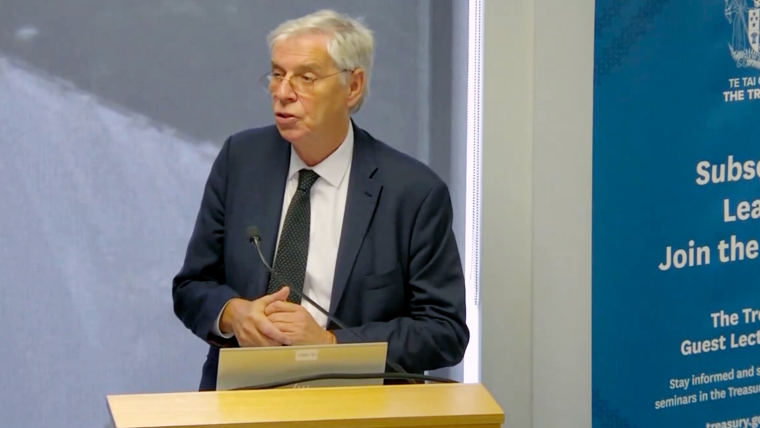
Michael Keen gives a public lecture at New Zealand Treasury in 2025
In Wellington, Mick delivered a Treasury Guest Lecture exploring how to future-proof New Zealand’s tax system in the face of rising fiscal pressures. The Trust also arranged meetings with Treasury, Inland Revenue, and politicians , where Mick discussed policy options.
In Auckland, the Trust hosted a public panel event “New Zealand’s Tax Future: Revenue, Investment and Global Challenges” where Mick presented alongside Robyn Walker (Deloitte) and Kelly Eckhold (Westpac).
The discussion explored the future of New Zealand’s tax system – from addressing revenue needs to navigating international tax pressures. Participants highlighted the urgency of reform, with projections showing debt could reach unsustainable levels approaching 190% of GDP without action. The debate ranged from the complexity of capital gains taxes (noting Australian CGT rules span 850 pages) to GST increases, which emerged as potentially efficient but with significant political constraints.
The Trust also organised roundtable discussions with leading tax practitioners, providing opportunities for in-depth technical discussions about New Zealand’s tax future.
Media Engagement
Michael Keen speaking with Jack Tame on Q+A
Keen’s insights reached broader audiences through strategic media appearances:
The NZ Initiative podcast “When Tax Policy Goes Wrong,” discussing cautionary tales from international experience.
Key Insights
Throughout his visit, several key themes emerged from Keen’s presentations: The Integration Challenge: Keen highlighted the inconsistency in New Zealand’s approach to capital gains taxation, arguing it deviates from the principled comprehensive income tax model the country otherwise follows.
The GST Opportunity: Keen reinforced New Zealand’s GST as world-class, and suggested this would be the first place to look if the Government was after revenue. He suggested that increasing the rate to the EU average could generate 4-4.5% of GDP in additional revenue, though compensation mechanisms for vulnerable populations require careful design.
Improving Productivity: Keen suggested that the corporate tax base was best placed to delivery productivity gains. He noted that the recent Investment Boost policy was a good example. He observed that NZ’s average effective tax rate on investment nonetheless remains high compared to the OECD average.
Capital Gains Tax? If NZ was to go to a comprehensive CGT (noting that we already tax some capital gains), Keen presented innovative solutions like accrual-equivalent capital gains schemes that could address economic distortions while maintaining administrative feasibility. Although no one had implemented a CGT in this way, Keen noted that NZ would have the capability to do this.
Taxing Wealth or Inheritance? Keen is not a fan of Wealth Taxes, and observed that other countries have voted with their feet by getting rid of them. He considers that they are ineffective, as the super wealthy can find loopholes, so only the middle group ends up paying them.
He does consider Inheritance Taxes to be superior to Wealth taxes, noting that the level at which the exemption is set is very important.
Lasting Impact
TPCT Chair Brendan Brown reflected: “You’ve done exactly what we hoped to achieve with your visit – challenged us to think about things in a different way.”
Keen offered both reassurance and challenge: “I don’t think New Zealand’s in a particularly bad position relative to others. Debt ratio is not that high and it’s not actually too hard to see where if you’re really pushed, you could raise some revenue. It’s great that New Zealand is thinking about it in a structured way – many other countries aren’t.”
The visit reinforced TPCT’s mission to ensure New Zealand benefits from leading international tax thinking. In an increasingly complex global tax environment, such exchanges are vital for developing robust, principled policies that can address our long-term fiscal challenges while maintaining what makes New Zealand’s tax system admired worldwide.
The Tax Policy Charitable Trust thanks Tax Management New Zealand, EY and Bell Gully for their support, and all participants who contributed to making Mick Keen’s visit a success.
Breaking New Ground: Joint Winners Announced at the 2024 Tax Policy Scholarship Competitionhttps://taxpolicycharitabletrust.org.nz/wp-content/uploads/2025/01/2024_10_22_TPSC_2024_403-Copy.jpg20611123Tinaz TataTinaz Tatahttps://secure.gravatar.com/avatar/ee33a5b721c7a2dd6583d0e469e679c3?s=96&d=mm&r=g
Proposals focused on enhancing tax compliance and equitable revenue-raising earned top honours in this year’s competition.
Now in its fifth year, the Tax Policy Scholarship Competition continues to push the boundaries of innovation in tax policy. This year, Matthew Seddon, a lawyer at Bell Gully, and Andrew Paynter, a policy advisor at Inland Revenue, were named joint winners. Their proposals addressed some of the most pressing challenges facing Aotearoa today—fiscal sustainability, equity, and the need for smarter approaches to enforcing existing tax compliance.
Claudia Siriwardena, a senior tax consultant at Deloitte, and Matthew Handford, a tax solicitor at Mayne Wetherell, were also celebrated as finalists.
The Tax Policy Scholarship Competition, run by the Tax Policy Charitable Trust and Tax Management New Zealand, invites entrants under 35 to propose improvements to New Zealand’s tax system, or analyse and suggest changes to address potential unintended consequences of existing laws. Each entrant’s proposal reflects their viewpoint, not the stance of any organisation or group, and aims to spark debate and discussion.
Joint winner Matthew Seddon’s proposal addresses tax compliance challenges posed by independent contractors, by extending PAYE withholding to independent contractors who principally provide services to persons with an existing PAYE obligation (employers) and those who operate through electronic marketplaces.
“The rise of the independent contractor is one of the biggest challenges to the integrity of the New Zealand tax system,” explains Matthew. “As more people turn to contracting, ensuring they comply with their tax obligations has become increasingly difficult, as they generally fall outside the PAYE rules.”
Depending on the information they provide to the employer or electronic marketplace, contractors would be subject to different withholding rates, ranging from 10% to 45%.
“Employers already have existing software and systems in place and electronic marketplaces have the size and scale to undertake the withholding – as we have recently seen following the imposition of GST on listed services – so this extension is both practical and achievable,” says Matthew. “It ensures greater compliance by independent contractors while minimising compliance and administration costs.”
The proposal promises significant benefits for the tax system; reduced underreporting (which in 2018 cost New Zealand an estimated $850 million annually) and simplifying the tax obligations for contractors. “The proposal isn’t a new tax,” says Matthew, “but a collection mechanism for existing tax liabilities to ensure contractors comply with their tax obligations.”
Reflecting on his win, Matthew says: “I feel on top of the world! It was an amazing experience, especially with the high calibre of the other finalists.” He says the support from the Bell Gully tax team has been incredible. “Their encouragement throughout the process has meant a lot to me, and having team members in the audience made the win even more special.”
The joint winners each receive $7,000 for their efforts. “I will invest most of it and put some towards the summer holidays with family and friends.”
Raising GST and offsetting regressivity
Andrew Paynter proposed an increase in the GST rate to 17.5%, coupled with a targeted tax credit to mitigate the impact of revenue-raising measures on low- to middle-income earners. This bold idea addresses two key challenges: the need for more government revenue and the risk of exacerbating inequality.
“The Crown’s future fiscal position is concerning, with spending forecast to outgrow revenue,” says Andrew. “Raising GST offers a solution because it taps into a broad base and comes with minimal economic impacts and no significant ongoing compliance costs. However, we can’t ignore the fact that increasing the rate of GST would affect lower-income households.”
The key innovation in the proposal lies in the design of the tax credit. The credit would be automated, individualised, indexed to inflation, and paid to those earning under $69,000 per year.
“My goal was to find a way to raise revenue while ensuring low-to-middle-income individuals were not negatively impacted,” says Andrew. “This competition allowed me to explore these issues and develop a solution that balances fiscal responsibility, contextual realities, and fairness.”
While GST increases often raise concerns about inflation, Andrew’s analysis showed the impact would be one-off and manageable and far less disruptive than other forms of taxation. “GST is an efficient revenue-raiser, and its economic impact would be limited compared to other tax increases.”
Andrew is grateful for the support he received throughout the competition: “I wouldn’t have reached this point without the encouragement of friends, colleagues, and mentors. Their belief in me made all the difference.”
His plans for the prize money? “It’s been fantastic to celebrate with everyone,” says Andrew. “I plan to use some of the prize money for a holiday!”
Judges balance ambition and practicality in joint decision
The 2024 judging panel consisted of Joanne Hodge, former tax partner at Bell Gully and member of the 2017 Tax Working Group; Craig Elliffe, professor of law at the University of Auckland and also a member of the 2017 Tax Working Group; Nick Clark, senior fellow in economics and advocacy at the New Zealand Initiative; and Chris Cunniffe, strategic advisor at TMNZ and past CEO of TMNZ.
“Andrew’s proposal was macro in scale—ambitious and forward-looking, tackling the fiscal challenges of the next 50 years by leveraging the most effective tool for driving revenue. We appreciated the simplicity and flexibility of his approach, but we also recognised the political challenges in getting such a significant reform implemented,” said the judges.
“Matthew’s proposal was much more specific, addressing a clear gap in compliance by extending an existing system. It offered practical solutions with ripple effects throughout the tax landscape. Faced with the challenge of evaluating two vastly different but equally compelling ideas, we had in-depth discussions and ultimately decided that both deserved to be recognised as joint winners.”
Inspiring the next generation of tax leaders
The prizes were presented by Inland Revenue Commissioner Peter Mersi. The Commissioner, with a confessed passion for policy, noted that this competition was unique, and in his experience, he has not seen the private sector provide a platform to promote good policy in this way.
Both Andrew and Matthew agree that the competition provided a unique opportunity to develop new ideas and engage with industry experts.
“The most memorable part of the experience was not just thinking through complex future challenges, but designing practical solutions for them. Having the space to develop my ideas and test them with some of the leading thinkers in the tax space was invaluable,” says Andrew.
Matthew says the competition is a fantastic way to build professional connections and hone written and presentation skills. “It’s been great to share my ideas before esteemed members of the tax policy community and it has further reinforced my passion for a career in tax.”
The success of this year’s winners reflects the value of encouraging fresh ideas and fostering innovation within the tax community. The Tax Policy Charitable Trust and Tax Management New Zealand are proud to support the next generation of professionals through initiatives like the Tax Policy Scholarship Competition, which helps ensure New Zealand’s tax system evolves to meet future challenges.
Find out more about the Tax Policy Scholarship Competition here.
To see Matthew’s and Andrew’s full submissions, click here.
Tax Policy Scholarship puts future tax leaders in the spotlighthttps://taxpolicycharitabletrust.org.nz/wp-content/uploads/2024/07/JR500559_LowRes.jpg91496099TaxpolicyTaxpolicyhttps://secure.gravatar.com/avatar/9feb775128cfbfb5aef2893052c7f8c5?s=96&d=mm&r=g
Four innovative young professionals have been selected as finalists in this year’s Tax Policy Scholarship Competition, a biannual prize hosted by the Tax Policy Charitable Trust.
The fifth edition of the competition, which supports the development of innovative tax policy research and thinking in Aotearoa New Zealand, is underway.
The Tax Policy Scholarship competition runs every two years to showcase the next generation of tax leaders. Entrants under the age of 35 are invited to propose changes to our tax system, analysing weaknesses in the current model and unintended consequences from existing tax rules.
Participants were invited to propose creative tax solutions backed by reasoned research and analysis. The competition attracted outstanding submissions from young professionals and bold ideas to overhaul inefficiencies in our system.
This year’s judges:
Joanne Hodge – Former tax partner at Bell Gully and a member of the 2017 Tax Working Group
Craig Elliffe – Professor of Law at The University of Auckland and a member of the 2017 Tax Working Group
Nick Clark – Senior Fellow, Economics and Advocacy at The New Zealand Initiative
Chris Cunniffe – Strategic Advisor at TMNZ (retired CEO, TMNZ)
The 2024 submissions showcased the bright future of the tax profession in New Zealand. We’re thrilled to announce the four finalists for this year’s award.
Our four finalists
Matthew Handford
Matthew is a Tax Solicitor at Mayne Wetherell. His submission was ‘ TLC for the Tax System’.
‘TLC’ stands for an independent Tax Law Commission to restore the Generic Tax Policy Process (GTTP). Matthew believes restoring GTTP would improve the quality of New Zealand tax law.
Under Matthew’s proposal, a TLC, independent of Inland Revenue, would have a standing mandate to systematically review the operation of New Zealand’s tax laws and make recommendations for their improvement.
Claudia Siriwardena
Claudia is a Senior Tax Consultant at Deloitte. Her submission proposed changes to New Zealand’s Fringe Benefit Tax regime.
Claudia said the current system was too complex and imposed high compliance costs on employers. She proposed a new small business FBT regime to simplify the rules around motor vehicles and unclassified benefits, reducing compliance costs and increasing revenue integrity.
Her proposal would also amend the current unclassified benefits rules to target only benefits provided to employees that would reasonably be viewed as provided in connection with their employment.
Matthew Seddon
Matthew is a lawyer at Bell Gully. His proposal focused on the underreporting of tax by independent contractors. Matthew said statistics showed that contractors underreport roughly 20% of their taxable income.
Matthew suggests withholding taxes should be extended to payments received by independent contractors engaged by persons with an existing PAYE withholding obligation (i.e., employers) and to those operating through electronic marketplaces. The withholding tax obligation would be at a 20% rate.
Andrew Paynter
Andrew works as a Policy Advisor at Inland Revenue. His submission focused on extracting more tax revenue in New Zealand without negatively impacting lower and middle-income earners.
Andrew noted the effectiveness of the GST in capturing tax. His suggestion is to increase the GST rate to 17.5% and introduce a GST refund tax credit for low- and middle-income individuals.
The GST refund credit would be a means-tested individualised credit paid at a flat rate to all resident individuals under a particular income threshold.
Selecting this year’s winner
The finalists were announced on July 4 at an event at Generator Auckland.
Each of the four will go on to develop a 4,000-word submission on their proposal, presenting their final idea and answering questions at a function on Tuesday 22 October in Wellington. The winner will be announced that evening.
Former winners debate the future of tax
The event to announce this year’s finalists also featured a panel discussion on the future of tax, featuring some of our past competition winners.
An engaging panel discussion on the sufficiency of New Zealand’s tax revenue was chaired by tax expert Geof Nightingale.
Vivien Lei (Senior Group Tax Advisor, Fisher & Paykel Healthcare)
Exploring current tax revenue sources and options for the future, the panel shared ideas on what the future of tax might look like in New Zealand.
Themes that were canvassed during the discussion and audience Q&A included:
The sustainability of New Zealand Superannuation under its current settings; options for changing those settings could include indexing to inflation rather than to wages, increasing the age of eligibility, and means-testing.
Key tax trends to watch and their connections to productivity. For example, a capital gains tax could make the tax system fairer and more equitable, but could also impact investment, entrepreneurship, and the flow of capital into the economy. It was also noted that environmental taxes were a “hot” trend in Europe. Taxes on items like plastic packaging could change behaviours and encourage efficiency improvements, leading to productivity gains and helping to address environmental issues.
The opportunity to increase tax revenues by better ensuring that tax owing under existing law is collected. It is well known that during the last few years, Inland Revenue has been less visible in its audit and investigatory work. A greater focus on audit and investigation work could be expected to identify areas of non-compliance and encourage greater levels of compliance in future.
The importance of economic growth and increased productivity in growing tax revenues. History has shown that growing the economy can lead to increased tax revenues to an extent that might far exceed the impact of new taxes.
Former Tax Policy Scholarship Competition winner and current Tax Policy Charitable Trust committee member Vivien Lei said it was “an honour to be on such an amazing panel”.
Finalists honoured
Brendan Brown, chair of the Tax Policy Charitable Trust, said the panel discussion highlighted both the talent and strong level of interest in the New Zealand tax system among up and coming tax professionals. He thanked the panellists (former winners of the Tax Policy Scholarship Competition) and Geof Nightingale as panel chair, for sharing their ideas in what was a thought-provoking discussion.
“I would also like to congratulate the four finalists in this year’s competition, and to thank everyone who entered the competition for their work in formulating their proposals. Participating in the competition and initiatives like it not only contributes to a better tax system but also provides excellent opportunities for those who participate.”
“The Tax Policy Charitable Trust was established some 12 years ago to encourage future tax policy leaders and lead tax policy thinking in New Zealand. I’d like to acknowledge the generosity of Ian Kuperus, the founder of TMNZ, in establishing the trust, and TMNZ for its tremendous support in enabling events like this to happen.”
Find out more about the Tax Policy Scholarship Competition here.
Emissions expert Ian Parry shares insights with NZ tax leaders https://taxpolicycharitabletrust.org.nz/wp-content/uploads/2024/04/iStock-114453154-scaled.jpg25601707TaxpolicyTaxpolicyhttps://secure.gravatar.com/avatar/9feb775128cfbfb5aef2893052c7f8c5?s=96&d=mm&r=g
New Zealand has been engaged in debate around emissions reduction targets and the policies needed to achieve them. Recently, the Tax Policy Charitable Trust sponsored a visit from Ian Parry, a leading international expert on climate change mitigation strategies, including carbon pricing and emissions trading schemes.
As the Principal Environmental Fiscal Policy Expert at the International Monetary Fund (IMF), Ian brings a wealth of relevant experience and research. Prior to joining the IMF in 2010, he held the prestigious Allen V. Kneese Chair in Environmental Economics at Resources for the Future, where he worked for 15 years. Ian also holds a PhD in economics from the University of Chicago, where his doctoral thesis, supervised by Nobel Laureate Gary Becker, focused on carbon taxation.
Ian’s current research examines the economic impacts and optimal design of a wide range of environmental, energy, and transportation policies. A central focus of his work is on the critical role of fiscal instruments, such as carbon pricing, in addressing environmental externalities and generating revenue.
During his visit to New Zealand, Ian engaged with various government departments, , to share his insights and he also delivered public lectures to tax professionals.
In Wellington, Ian presented with James Every-Palmer from Lawyers for Climate Action to discuss the strengths and limitations of New Zealand’s carbon pricing system. In Auckland, he held a public lecture at the University of Auckland, exploring the global context of environmental challenges, the role of mitigation instruments, and ways to enhance the acceptability of such policies and broader environmental concerns. Ian concluded his presentation with observations specifically focused on Aotearoa .
Ian’s expertise extends beyond his scholarly work. He has published over 50 papers in professional journals and authored numerous other publications, including the books “Fiscal Policy to Mitigate Climate Change: A Guide for Policymakers,” “Issues of the Day: 100 Commentaries on Environmental, Energy, Transportation, and Public Health Policy,” “Getting Energy Prices Right: From Principle to Practice,” and “Implementing a US Carbon Tax: Challenges and Debates.”
The Tax Policy Charitable Trust has a history of bringing distinguished experts to New Zealand, with previous visiting lecturers including David Bradbury, Deputy Director for the Centre of Tax Policy and Administration at the OECD, Michael Keen, former Deputy Director of the IMF’s Fiscal Affairs Department, and Joel Slemrod, an American economist and professor of economics and public policy at the University of Michigan.
Inspirational idea wins Tax Policy Scholarship Competitionhttps://taxpolicycharitabletrust.org.nz/wp-content/uploads/2022/12/CBM4075-scaled.jpg25601707TaxpolicyTaxpolicyhttps://secure.gravatar.com/avatar/9feb775128cfbfb5aef2893052c7f8c5?s=96&d=mm&r=g
A game-changing idea to fight climate change won this year’s Tax Policy Charitable Trust Scholarship.
Each year, the Tax Policy Charitable Trust (supported by TMNZ) awards a scholarship to celebrate the brightest young minds in the industry, and 2022’s submissions were as inspirational as ever.
Entrants were invited to submit ideas that could transform New Zealand’s tax landscape, looking at either environmental taxation, tax administration, or the powers granted to the Commissioner of Inland Revenue to collect information.
The competition, open to people aged 35 and under, generated progressive and innovative ideas from the industry’s young leaders. In the end, one entrant was selected as this year’s winner for her outstanding approach to New Zealand’s tax and environmental challenges.
And the winner is….
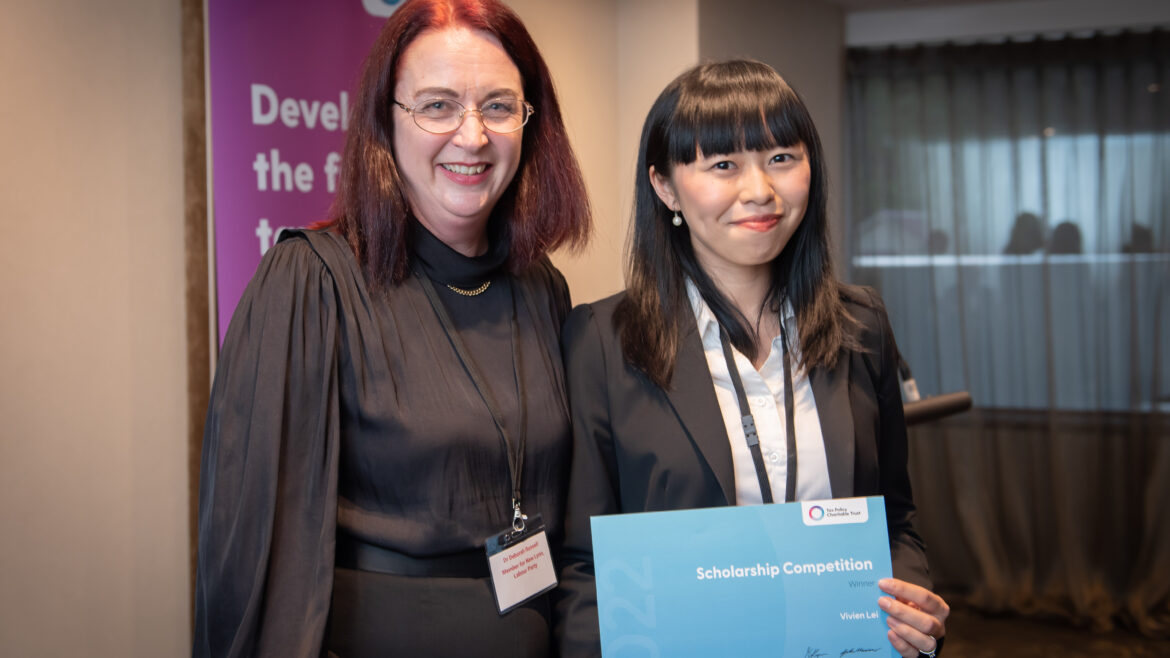
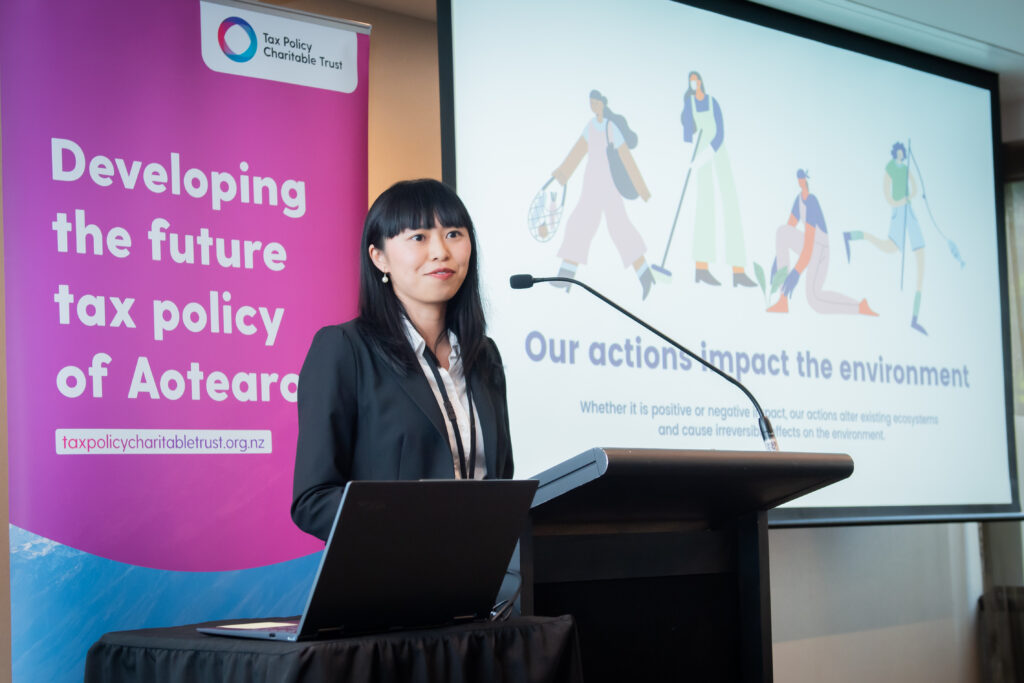
Vivien Lei, Group Tax Advisor at Fisher & Paykel Healthcare, won this year’s scholarship for her submission to introduce Impact Weighted Taxation in New Zealand, an innovative idea that would see businesses pay taxes based on their environmental impact.
A panel of leading industry professionals judged Lei’s proposal as the winner among a strong field of candidates. Mitchell Fraser, Daniel Doughty, and Jordan Yates were also celebrated as finalists in the competition.
Lei was crowned the winner at the Tax Policy Charitable Trust’s finals evening on October 19, after each finalist presented their idea to an audience of industry professionals.
Trust Chair John Shewan said the judges were “delighted to see passion and energy behind the submissions and supporting presentations”.
Lei, who received a $10,000 cash prize, described the competition as “an amazing experience”.
“You don’t often get many opportunities to think creatively about tax policy, so this was a nice space to do that,” Lei says. “Being able to develop my policy thinking and talk to some of the leading experts was really great — and winning was a huge surprise!”
This year was Lei’s second attempt to win the scholarship following an earlier submission in 2019. Her perseverance and positive attitude paid off.
“I entered when I was still very green in my career,” she says. “Since then, I’ve been mentored by amazing people who have helped with my development, particularly Rachael Bull, Head of Tax at Fisher & Paykel Healthcare, and Joseph Chueh who fostered my interest in tax policy. I was grateful to have their support this time around.”
Tax to fight the climate threat
Lei’s background in the social impact sector and personal concerns about the environment informed her submission idea.
“These are the most difficult problems of our time,” she says. “I’m hoping my idea will bring the conversation to the fore and spark other young minds in our industry to think about how tax might influence positive environmental outcomes.”
The Tax Policy Scholarship Competition is proudly supported by TMNZ, which invests 100% of its profits back into the environment and community, through strategic philanthropic partner, Whakatupu Aotearoa Foundation. Lei believes that tax professionals can help to build a better future for Aotearoa.
“It’s scary to think about the trajectory we are on with our natural capital, so it’s important for our industry to think of ways to help,” she adds.
Vivien Lei, presenting her proposal to introduce Impact Weighted Taxation in New Zealand
Inspiring future tax leaders
Tax Policy Scholarship Competition Judges commented that this year’s entrants will inspire future generations as well as today’s professionals.
“This competition is all about supporting and inspiring future tax policy leaders. The results from this year and from earlier years’ competitions reflect the presence of emerging talent that will ensure the continuation of leading tax policy research and thinking in New Zealand,” said the judges.
Find out more about the Tax Policy Scholarship Competition here.